
Post Office Box 4337 ●
www.ria.edu/rup
www.riaUpress.com
THE DEATH AND ANTI-DEATH
SERIES (Click
Here)
THE CULTURAL CLASSICS
SERIES (Click
Here)
ADDITIONAL BOOKS FROM RIA
UNIVERSITY PRESS (Click Here)
ABOUT THE EDITOR-IN-CHIEF
AND THE ASSISTANT EDITOR (Click Here)
WOULD YOU LIKE TO SUBMIT A
MANUSCRIPT? (Click Here)
_________________________________________________
THE DEATH AND ANTI-DEATH SERIES
(To Order A Book,
Click On The Book Title)
The Death And Anti-Death Series By
_________________________________________________
Death And Anti-Death, Volume 1:
One Hundred Years After N. F. Fedorov
(1829-1903)
Charles Tandy, Ph.D., Editor
Volume One ISBN-13: 978-0-9743472-0-2 (Hardback)
Volume One ISBN-10: 0-9743472-0-5 (Hardback)
Distributed By Ingram
The anthology discusses a number of
interdisciplinary cultural, psychological, metaphysical, and moral issues and
controversies related to death, life extension, and anti-death. This first
volume in the series is in honor of the 19th century Russian philosopher N. F. Fedorov. (Some of the contributions are about Fedorov; most are not.) Each of the 17 chapters includes a
selected or short bibliography. The anthology also contains an Introduction and
an Index -- as well as an Abstracts section that serves as an extended table of
contents.
A variety of differing points of view
are presented and argued. Most of the 400-plus pages consist of contributions
unique to this volume. Although of interest to the general reader, the
anthology functions well as a textbook for university courses in culture
studies, death-related controversies, ethics, futuristics,
humanities, interdisciplinary studies, life extension issues, metaphysics, and
psychology.
The titles of the contributions are as
follows:
[Introduction:] N. F. Fedorov And The Common Task: A 21st Century Reexamination by Charles Tandy
[PART I: Cultural And Psychological Perspectives]
1. The Resurrection Of Nikolai Fedorov
As A Russian Philosopher by James P. Scanlan
2. The Search For A Practical Immortality: Fedorov And Yoga by George M.
Young
3. Death And Anti-Death In Russian Marxism At The
Beginning Of The 20th Century
by Daniela Steila
4. Death And Anti-Anti-Death: A Cultural
Exploration by Giorgio Baruchello
5. The Evolution Of Death Understanding by Anthony S. Dawber and David S. Stodolsky
6. Hypnos And Thanatos:
Dreams, Death And The Eternal Return by Scott David O'Reilly
7. Certain And Uncertain Matters by Werner J. Wagner
8. Who's Afraid Of Life
Extension? by Harry
R. Moody
9. Fear Of Death And The Quest For Immortality by
Robert R. Newport
[PART II: Metaphysical And Moral Perspectives]
10. Six Philosophical
Controversies About Death
by Steven Luper
11. Warranted Regretability Maneuvers And The Deprivation View Of Death's
Badness by Richard Greene
12. The Deprivation
Account Of Death's
Badness And Siverstein's Challenge
by John M. Collins
13. The Harm Of Death by William Grey
14. More Solutions To The
Puzzle Of When Death Harms Its Victims? by Julian Lamont
15. When Is One Harmed By
One's Own Death? by Jack Li (Author now known as Jack Lee)
16. Letting The Dead Bury Their Own Dead: A Reply To Palle Yourgrau by
17. Unburying The Dead: Posthumous Harms And Posthumous
Benefits -- A Solution To The Missing Subject Problem by Charles Tandy
_________________________________________________
Death And Anti-Death, Volume 2:
Two Hundred Years After Kant, Fifty Years After Turing
Charles Tandy, Ph.D., Editor
Volume Two ISBN-13: 978-0-9743472-2-6 (Hardback)
Volume Two ISBN-10: 0-9743472-2-1 (Hardback)
Distributed By Ingram
The following contributions are
original to this volume of the Death And Anti-Death Series By
> Is The Universe Immortal?: Is
Cosmic Evolution Never-Ending? by Charles Tandy
> Death As Metaphor by
> Fantasies Of Immortality by Werner J.
Wagner
> What Will The Immortals Eat? by George M.
Young
> Cultural Death Understanding by Anthony S. Dawber
> Death And Immortality: Plato, Aristotle, Aquinas
And Descartes On The Soul by Carol
O’Brien
> Against The Immortality Of The Soul by Matt
McCormick
> Why Death Is (Probably) Bad For You: A Common Sense Approach by
R.C.W. Ettinger
> Resurrecting Kant's Postulate Of Immortality by Scott R.
Stroud
> Immortality and Finitude: Kant's Moral Argument Reconsidered by
Douglas
Burnham
> Death, Harm, And The Deprivation Theory by Jack Li (Author
now known as Jack Lee)
> To Be Or Not To Be: The Zombie In The Computer
by R.C.W. Ettinger
> The Future Of Human Evolution by Nick Bostrom
> Earthlings Get Off Your Ass Now!: Becoming
Person, Learning Community by Charles
Tandy
_________________________________________________
Death And Anti-Death, Volume 3:
Fifty Years After Einstein,
One Hundred Fifty Years After Kierkegaard
Charles Tandy, Ph.D., Editor
Volume Three ISBN-13: 978-0-9743472-6-4 (Hardback)
Volume Three ISBN-10: 0-9743472-6-4 (Hardback)
Distributed By Ingram
Volume
Three in the Death And Anti-Death Series By
The titles of the 17 chapters are as
follows:
1. Death And Life Support Systems: A Novel Cultural
Exploration by Giorgio Baruchello
2. Recent Developments In The Ethics, Science, And Politics Of
Life-Extension by Nick Bostrom
3. Life, And The Concept Of A Relativistic Field In
Kant by Douglas Burnham
4. Towards An
Ethics Of Ontogeny by Anthony S. Dawber
5. An Easy Death by Mikhail Epstein
6. Fear Of Death And Muddled Thinking – It Is So Much Worse
Than You Think by Robin Hanson
7. The Illusiveness Of Immortality by James J. Hughes
8. A Question Of Endings by
9. What Is Left After Death? by Jack Lee
10. Life Extension And Pleasure: Can The Prolongation
Of (Self) Consciousness Deliver Greater Pleasure Or Happiness? by Carol O’Brien
11. Raising The Dead Scientifically: Fedorov's Project In A Modern Form by R. Michael
Perry
12. The Emulation Argument: A Modification Of Bostrom's Simulation Argument by Charles Tandy
13. Managing The Consequences Of Rapid Social Change by
Natasha Vita-More
14. Eros And Thanatos – The Establishment Of Individuality
by Werner J. Wagner
15. Universal Superlongevity: Is It Inevitable
And Is It Good? by Mark Walker
16. Return To A Pristine Ecosphere Via Molecular
Nanotechnology by Sinclair T. Wang
17. Fedorov's Legacy:
The Cosmist View Of Man's Role In The Universe by George
M. Young
_________________________________________________
Death And Anti-Death, Volume 4:
Twenty Years After De Beauvoir,
Thirty Years After Heidegger
Charles Tandy, Ph.D., Editor
Volume Four ISBN-13: 978-0-9743472-8-8 (Hardback)
Volume Four ISBN-10: 0-9743472-8-0 (Hardback)
Distributed By Ingram
Volume Four, as indicated by the
anthology's subtitle, is in honor of Simone de Beauvoir (1908-1986) and Martin
Heidegger (1889-1976). The chapters do not necessarily mention Simone de
Beauvoir or Martin Heidegger. The 16 chapters (by professional philosophers and
other professional scholars) are directed to issues related to death, life
extension, and anti-death. Most of the 400-plus pages consist of scholarship
unique to this volume. Includes index.
The titles of the 16 chapters are as
follows:
1. Mechanism, Galileo’s Animale And Heidegger’s Gestell:
Reflections On The Lifelessness Of Modern Science by GiorgioBaruchello
2. Simone De Beauvoir by Debra Bergoffen
3.
Existentialism by Steven Crowell
4. Time Wounds All Heels
by William Grey
5. The Ethical Importance Of Death by Jenann Ismael
6.
The Poetics Of Death:
Intimations And Illusions by Lawrence
7. Death And Aesthetics by Keith Lehrer
8. Ageing And Existentialism: Simone De Beauvoir And
The Limits Of Freedom by Shannon M. Mussett
9. Life Extension And Meaning by Carol O’Brien
10. Consciousness As Computation: A Defense Of Strong AI
Based On Quantum-State Functionalism by R. Michael
Perry
11. Reality Shifts: On The Death And Dying Of Dr. Timothy Leary
by Carol Sue Rosin
12. Extraterrestrial
13. A Time Travel Schema And Eight Types Of Time Travel by Charles
Tandy
14. Boredom, Experimental
Ethics, And Superlongevity by Mark Walker
15. Exopolitics: The Death Of Death by Alfred Lambremont Webre
16. Embryo Cloning:
_________________________________________________
Death And Anti-Death, Volume 5:
Thirty Years After Loren Eiseley (1907-1977)
Charles Tandy, Ph.D., Editor
ISBN 978-1-934297-02-5 (Hardback)
Distributed By Ingram
Volume 5, as indicated by the
anthology's subtitle, is in honor of Loren Eiseley (1907-1977). The chapters do not
necessarily mention him. The chapters (by professional philosophers and other
professional scholars) are directed to issues related to death, life extension,
and anti-death. Most of the contributions consist of scholarship unique to this
volume. As was the case
with all previous volumes in the Death And Anti-Death Series By Ria University
Press, the anthology includes an Index as well as an Abstracts section that
serves as an extended table of contents. (With Volume 5, you will also find a
new section entitled BRIEF COMMUNICATIONS.)
The 17 chapter titles are as follows:
1. Asking The Unaskable Question – Do People Have The Right
NOT To Die? by Marcus
Barber
2. Deadly Economics: Reflections On The Neoclassical Paradigm by Giorgio Baruchello
3. A Frozen Future?
Cryonics As A
Gamble by Gregory Benford
4. Three Big Problems by
Nick Bostrom and
Rebecca Roache
5. A World Of Exception: Exploring The Thought Of
Loren Eiseley by
Marcus Bussey
6. Knowledge And Death: Return To The Garden by Harry Hillman Chartrand
7. Is It Safe For A
Biologist To Support Cryonics Publicly? by Aubrey D.N.J. de
Grey
8. Taking The Defeat Of Aging Seriously: The Time Is
Now by Aubrey D.N.J. de
Grey
9. Choosing Death In Cases
Of Anorexia Nervosa – Should We Ever Let People Die From Anorexia? by Simona
Giordano
10. Technologies Don’t Die by Kevin
Kelly
11. Intimate Moments Among The Dead: Death And Time In The Work
Of Loren Eiseley by
12. No Turning Back:
Past-Directed Time Travel Is Scientifically Unlikely, Though Virtual
Alternatives May Still Offer Solace by R. Michael
Perry
13. Embodiments Of
14. On Death And Dying: Summing Up At 70 by Arthur B. Shostak
15.
Once Upon A Time
by Stanley
16. Teleological Causes And The Possibilities Of Personhood by
Charles
Tandy
17. Terrestrial Peoples,
Extraterrestrial Persons by Charles Tandy
_________________________________________________
Death And Anti-Death, Volume 6:
Thirty Years After Kurt Gödel (1906-1978)
Charles Tandy, Ph.D., Editor
ISBN 978-1-934297-03-2 (Hardback)
Distributed By Ingram
Volume 6, as indicated by the
anthology's subtitle, is in honor of Kurt
Gödel (1906-1978). The chapters
do not necessarily mention him. The chapters (by professional philosophers and
other professional scholars) are directed to issues related to death, life
extension, and anti-death, broadly construed. Most of the contributions consist
of scholarship unique to this volume. As
was the case with all previous volumes in the Death And Anti-Death Series By
Ria University Press, the anthology includes an Index as well as an Abstracts
section serving as an extended table of contents. (Volume 6 also includes a
BRIEF COMMUNICATIONS section.)
The ten chapters are entitled as
follows:
1. Life And Death
Economics: A Dialogue by Giorgio Baruchello and Valerio Lintner (pages 33-52)
2. Charles Hartshorne by
Daniel A. Dombrowski (pages
53-78)
3. Choosing Death in Cases
of Anorexia Nervosa – Should We Ever Let People Die From Anorexia? PART II by Simona Giordano (pages
79-100)
4. The Ethics Of Enhancement by Bill
Grote and William Grey (pages
101-126)
5. Cosmology And Theology by John
Leslie (pages
127-156)
6. Positive Logicality:
The Development Of Normative Reason by J. R. Lucas (pages
157-222)
7. The Basic Ideas Of Conformal Cyclic Cosmology by Roger
Penrose (pages
223-242)
8. Deconstructing Deathism:
Personal Immortality As A Desirable Outcome by R. Michael Perry (pages 243-264)
9. What Mary Knows: Actual
Mentality, Possible Paradigms, Imperative Tasks by Charles Tandy (pages
265-284)
10. The Future Of Scientific Simulations: From Artificial
Life To Artificial Cosmogenesis by Clément Vidal (pages
285-318)
_________________________________________________
Death And Anti-Death, Volume 7:
Nine Hundred Years After St. Anselm (1033-1109)
(HARDCOVER)
Distributed By Ingram
Death And Anti-Death, Volume 7:
Nine Hundred Years After St. Anselm (1033-1109)
(PAPERBACK)
Distributed By Ingram
Death And Anti-Death, Volume 7: Nine Hundred
Years After St. Anselm (1033-1109) is
edited by Charles Tandy, Ph.D.: ISBN 978-1-934297-05-6 is the Hardback edition
and ISBN 978-1-934297-07-0 is the Paperback edition.
Volume 7, as indicated by the
anthology's subtitle, is in honor of St. Anselm (1033-1109). The chapters do
not necessarily mention him (but some chapters do). The chapters (by
professional philosophers and other professional scholars) are directed to
issues related to death, life extension, and anti-death, broadly construed.
Most of the contributions consist of scholarship unique to this volume. As was
the case with all previous volumes in the Death And Anti-Death Series By Ria
University Press, the anthology includes an Index as well as an Abstracts
section that serves as an extended table of contents. (Volume 7 also has a
BRIEF COMMUNICATIONS section.)
Volume 7 includes chapters by some of
the world's leading living thinkers, including:
-----Philosopher of in vitro meat - Brian
J. Ford;
-----Medievalist philosopher - Jasper
Hopkins;
-----Today's "Thomas Edison" -
Ray Kurzweil;
-----
-----Ontological argument experts - Graham Oppy ("Nay") and Charles
Taliaferro ("Yea").
There are 16 chapters, as follows:
1.-----CHAPTER ONE Life And Death Economics
Revisited: Reflections On The Economic Crisis One Year On (by Giorgio Baruchelloand Valerio Lintner)
pages 35-54;
2.-----CHAPTER TWO Culturing Meat For The Future:
Anti-Death Versus Anti-Life (by Brian J. Ford) pages 55-80;
3.-----CHAPTER THREE Contrasting Conceptions Of
4.-----CHAPTER FOUR Hormones Of Youth (by Ray Kurzweil and Terry Grossman) pages 101-156;
5.-----CHAPTER FIVE Prenatal Nonexistence (by
Jack Lee) pages 157-168;
6.-----CHAPTER SIX The Search For The Ultimate
(by J. R. Lucas) pages 169-210;
7.-----CHAPTER SEVEN The Urgent Need For An
Academic Revolution: The Rational Pursuit Of Wisdom (by Nicholas Maxwell) pages
211-238;
8.-----CHAPTER EIGHT Limitless Life: The
Psychology Of Forever (by Max More) pages 239-274;
9.-----CHAPTER NINE Anselm's First Argument (by
Graham Oppy) pages 275-296;
10.-----CHAPTER TEN God Versus The Multiverse:
An Ontological Argument Against The Existence Of A Supreme Being, With A
Hopeful Alternative (by R. Michael Perry) pages 297-312;
11.-----CHAPTER
ELEVEN Living Towards Eternal Life: Saint Anselm's Christian Anthropology (by
Gregory B. Sadler) pages 313-346;
12.-----CHAPTER TWELVE The Anselmian Ontological Argument As The Ultimate
Anti-Death Argument: Suggestions On How To Reason From Possible Divine
Perfection To Actual Divine Perfection (by Charles Taliaferro) pages 347-372;
13.-----CHAPTER
THIRTEEN The Breadth Of Theism Defense: Redemption And The Problem Of Evil (by
Charles Taliaferro and JacobZillhardt)
pages 373-392;
14.-----CHAPTER
FOURTEEN Personal, Temporal, And Paragonal Aspects Of
The Omniverse (by Charles Tandy) pages 393-450;
15.-----CHAPTER
FIFTEEN A Philosopher Looks At Posthumanity:
Inconclusive Conclusions? (by Charles Tandy) pages 451-468;
16.-----CHAPTER
SIXTEEN O'Neill-Type Space Habitats And The Industrial Conquest Of Space (by P. Ulmschneider)
pages 469-494.
-----The INDEX begins on page 495.
_________________________________________________
Death And Anti-Death, Volume 8:
Fifty Years After Albert Camus (1913-1960)
(Available in HARDBACK and in PAPERBACK)
Distributed By Ingram
Death And Anti-Death, Volume 8: Fifty Years After Albert Camus
(1913-1960) is edited by Charles Tandy, Ph.D.: ISBN
978-1-934297-10-0 is the Hardback edition and ISBN 978-1-934297-11-7 is the
Paperback edition.
Volume 8, as indicated by the
anthology's subtitle, is in honor of Albert
Camus (1913-1960). The
chapters do not necessarily mention him (but some chapters do). The chapters
(by professional philosophers and other professional scholars) are directed to
issues related to death, life extension, and anti-death, broadly construed.
Most of the contributions consist of scholarship unique to this volume. As was the case with all previous
volumes in the Death And Anti-Death Series By Ria University Press, the
anthology includes an Index as well as an Abstracts section that serves as an
extended table of contents. (Volume 8 also includes a BRIEF COMMUNICATIONS
section.)
Volume 8 includes chapters by some of
the world’s leading living thinkers and doers, including:
------Gregory M. Fahy (Founder of biological vitrification research for large-scale organ banking)
------J. R. Lucas
(Inventor of a version of the Gödelian Argument that minds are not mere
machines)
------John Searle (Inventor of the Chinese Room Argument
against Strong Artificial Intelligence).
There are 18 chapters, as follows:
1.------CHAPTER ONE Homer,
Heroes And Humanity: Vico’s New Science On Death And Mortality (by Giorgio Baruchello) pages 33-52;
2.------CHAPTER
TWO Cryonics:
A Scientific Challenge To Death (by Benjamin P. Best) pages 53-78;
3.------CHAPTER THREE Primary
Institutions (by Thomas O. Buford) pages 79-90;
4.------CHAPTER FOUR Physical And Biological Aspects Of Renal
Vitrification (by Gregory M.
Fahy et al.) pages 91-120;
5.------CHAPTER FIVE Latest Advances In Antiaging Medicine (by Terry Grossman) pages
121-146;
6.------CHAPTER SIX The Will To Believe (by William James) pages 147-170;
7.------CHAPTER SEVEN Politics, Death, And Camus’s Late Anarchic Style (by
John Randolph LeBlanc) pages 171-198;
8.------CHAPTER EIGHT Can One Be Harmed Posthumously? (by Jack
Lee) pages 199-210;
9.------CHAPTER NINE The Gödelian Argument: Turn Over The Page (by J. R.
Lucas) pages 211-224;
10.------CHAPTER TEN The Function Of Assisted Suicide In
The System Of Human Rights (by Ludwig
A. Minelli) pages 225-234;
11.------CHAPTER ELEVEN Death,
Resurrection, And Immortality: Some Mathematical Preliminaries (by R. Michael
Perry) pages 235-292;
12.------CHAPTER TWELVE The Chinese
Room Argument (by John Searle) pages 293-302;
13.------CHAPTER
THIRTEEN What’s Best For Us (by Asher Seidel) pages 303-332;
14.------CHAPTER
FOURTEEN Camus, Plague Literature, And The Apocalyptic Tradition (by David
Simpson) pages 333-362;
15.------CHAPTER
FIFTEEN The Absurd Walls Of Albert Camus (by Charles Taliaferro) pages 363-378;
16.------CHAPTER
SIXTEEN Camusian
Thoughts About The Ultimate Question Of Life (by Charles Tandy) pages 379-401;
17.------CHAPTER
SEVENTEEN The UP-TO Project: How To Achieve World Peace, Freedom, And
Prosperity (by Charles Tandy) pages 401-418);
18.------CHAPTER
EIGHTEEN Life And Death, And The Identity Problem (by James Yount)
pages 419-448.
------The INDEX begins on page 449.
_________________________________________________
Death And Anti-Death, Volume 9:
One Hundred Years After Wilhelm Dilthey (1833-1911)
(Available in HARDBACK and in PAPERBACK)
Distributed By Ingram
Death And Anti-Death, Volume 9: One Hundred Years After Wilhelm Dilthey
(1833-1911) is edited by Charles Tandy, Ph.D.: ISBN 978-1-934297-13-1 is the
Hardback edition and ISBN 978-1-934297-14-8 is the Paperback edition.
Volume 9, as indicated by the
anthology's subtitle, is in honor of Wilhelm Dilthey (1833-1911). The chapters do not necessarily
mention him (but some chapters do). The chapters (by professional philosophers
and other professional scholars) are directed to issues related to death, life
extension, and anti-death, broadly construed. Most of the contributions consist
of scholarship unique to this volume. As was the case with all previous
volumes in the Death And Anti-Death Series By Ria University Press, the
anthology includes an Index as well as an Abstracts section that serves as an
extended table of contents. (Volume 9 also includes a BRIEF COMMUNICATIONS
section.)
Volume 9 includes chapters by some of
the world’s leading living thinkers and doers. There are 13 chapters, as
follows:
1.------CHAPTER ONE Contingency,
Autonomy And Inanity: Cornelius Castoriadis On Human Mortality (by Giorgio Baruchello) pages 27-54;
2.------CHAPTER TWO Cryonics: Introduction And Technical Challenges (by Ben Best) pages
55-74;
3.------CHAPTER THREE Technological
Revolutions: Ethics And Policy In The Dark (by Nick Bostrom)
pages 75-108;
4. ------CHAPTER FOUR Is Personalism Dead At
5.------CHAPTER FIVE Practical Lessons In Preparing For Cryonic Suspension: The Example
Of Robert Ettinger, Patient 106 (by DavidEttinger and
Connie Ettinger) pages 137-146;
6.------CHAPTER SIX Bad Metaphysics Does Not Make For Good Science (by Gary L. Herstein)
pages 147-164;
7.------CHAPTER SEVEN Open Theism (by J. R. Lucas) pages 165-174;
8.------CHAPTER EIGHT Fostering Death In A Culture Of Life: The Ambiguous Legacy Of The
Marketing Of Cryonics (by David Pascal) pages 175-198;
9.------CHAPTER NINE Agony As Entrancement: Dying Out Of Too Much Life: Emil Cioran And The Metaphysical Experience Of
Death (by Horia Patrascu) pages 199-226;
10.------CHAPTER TEN Options For Proactive Cryopreservation (by R.
Michael Perry) pages 227-236;
11.------CHAPTER ELEVEN The Many Worlds Of Dilthey: A Modest
Defense Of The Irreducibility Of Meaning (by Charles Taliaferro) pages 237-248;
12.------CHAPTER TWELVE John Rawls And The Death Of Scarcity: A “Force Of Nature”
Original Position (by Charles Tandy) pages 249-280;
13.------CHAPTER THIRTEEN The Convergence
Of Nanotechnology, Biotechnology And Information Technology – The PotentialUnlimited Renewable Resource Generation For The
Extension Of Sustainability (by Sinclair T. Wang) pages 281-328.
------The INDEX begins on page 329.
_________________________________________________
Death And Anti-Death, Volume 10:
Ten Years After John Rawls (1921-2012)
(Available in HARDBACK and in PAPERBACK)
Distributed By Ingram
Death And Anti-Death, Volume 10: Ten Years After John Rawls
(1921-2002) is edited by Charles Tandy, Ph.D. and Jack Lee, Ph.D.: ISBN
978-1-934297-15-5 is the Hardback edition and ISBN 978-1-934297-16-2 is the
Paperback edition.
Volume 10, as indicated by the
anthology's subtitle, is in honor of John Rawls (1921-2002). The chapters do
not necessarily mention him (but some chapters do). The chapters (by
professional philosophers and other professional scholars) are directed to
issues related to death, life extension, and anti-death, broadly construed.
Most of the contributions consist of scholarship unique to this volume.
As was the case with all previous volumes in the Death And Anti-Death Series By
Ria University Press, the anthology includes an Index as well as an Abstracts
section that serves as an extended table of contents.
There are 11 chapters, as follows:
1.------CHAPTER ONE
Autonomy, Contingency, And Mysticism: Three Critical Remarks On Cornelius Castoriadis’
Understanding Of Human Mortality (by Giorgio Baruchello) pages 21-30;
2.------CHAPTER TWO Heidegger And Daoism On Mortality (by Wing-cheuk Chan)
pages 31-54;
3.------CHAPTER THREE Autonomy In Moral And Political
Philosophy (by John Christman) pages 55-94;
4.------CHAPTER FOUR A Fortunate Academic Life (by William
Grey) pages 95-100;
5.------CHAPTER FIVE Who Is The Subject Of The Evil Of Death?
(by Jack Lee) pages 101-114;
6.------CHAPTER SIX Is Death Necessarily Harmful? Some Reflections From A Daoist Perspective (by Shui-Chuen Lee) pages 115-130;
7.------CHAPTER SEVEN Our Global Problems And
What We Need To Do About Them (by Nicholas Maxwell) pages 131-174;
8.------CHAPTER EIGHT Optimizing One’s Immortality: Biostasis And The Philosophy Of Universal Immortalism (by R. Michael Perry) pages 175-212;
9.------CHAPTER NINE A Brief Inquiry Into Rawls’ Religion:
10.------CHAPTER TEN John Rawls, Albert Camus, And Our
Common Task Of Intergenerational Justice (by Charles Tandy) pages 225-254;
11.------CHAPTER ELEVEN John Rawls (by Leif Wenar)
pages 255-300;
------The INDEX begins on
page 301.
_________________________________________________
Death And
Anti-Death, Volume 11:
Ten Years After Donald Davidson (1917-2003)
(Available in HARDBACK and in PAPERBACK)
Distributed By Ingram
The Death And
Anti-Death Series By
Volume 11, as indicated by the
anthology's subtitle, is in honor of Donald Davidson (1917-2003). The chapters do not necessarily
mention him (but some chapters do). The chapters (by professional philosophers
and other professional scholars) are directed to issues related to death, life
extension, and anti-death, broadly construed. Most of the contributions consist
of scholarship unique to this volume. As
was the case with all previous volumes in the Death And Anti-Death Series By
Ria University Press, the anthology includes an Index as well as an Abstracts
section that serves as an extended table of contents.
There are 12 chapters, as follows:
1.------CHAPTER ONE
Do We Really Want Immortality? (by David Brin) pages 25-42;
2.------CHAPTER TWO The Importance Of Being Identical: On
How Not To Derive A Contradiction Within A Metaphysical Theory (by
3.------CHAPTER THREE In Saecula Saeculorum? Bioscience, Biotechnology And The Construct Of Death: A Neurobioethical
View (by Christine Fitzpatrick and James Giordano) 61-80;
4.------CHAPTER FOUR
Making Death Worth Its Cost: Prolegomena To Any Future Necronomics
(by Steve Fuller) 81-92;
5.------CHAPTER FIVE
On What Persists After Death (by Vladimir V. Kalugin)
93-104;
6.------CHAPTER SIX Extreme Lifespans Via
Perpetual-Equalising Interventions: The ELPIs
Hypothesis (by Marios Kyriazis)
105-124;
7.------CHAPTER
SEVEN What Philosophy Ought To Be (by Nicholas Maxwell) 125-162;
8.------CHAPTER
EIGHT Resurrecting The Dead Through
Future Technology: Parallel Recreation As An Alternative To Quantum Archaeology
(by R. Michael Perry) 163-172;
9.------CHAPTER NINE
Supervenient Spirituality And The Meaning Of Life (by
Gabriel Segal) 173-190;
10.------CHAPTER
TEN What Might It Take To Get From
Donald Davidson’s Mature Philosophical Position To Recognize The Possibility,
And Even Plausibility, Of An Afterlife? (by Charles
Taliaferro and Christophe Porot) 191-210;
11.------CHAPTER
ELEVEN Roger Penrose, Rupert Sheldrake,
And The Future Of Consciousness (by Charles Tandy) 211-228;
12.------CHAPTER TWELVE Rational Suicide And
Global Suicide In The Amor Fati Of Modal Totality (by Sascha
Vongehr) 229-268;
------The
INDEX begins on page 269.
_________________________________________________
(To Order A Book,
Click On The Book Title)
The Cultural Classics Series By
_________________________________________________
Robert C. W. Ettinger
(Charles Tandy, Ph.D., Editor)
ISBN-13: 978-0-9743472-3-3
(Hardback)
ISBN-10: 0-9743472-3-X
(Hardback)
Distributed By Ingram
This 2005 edition contains an exact
replica copy of the complete first edition of Robert Ettinger's 1964 cultural classic, The Prospect of Immortality. (Note:
James Bedford began his journey as "the first cryonaut" on January 12, 1967; as of 2005, he and many others remain
in cryonic hibernation.)
Additional materials include three
original (2005) paper contributions:
(1) "Ettinger's 1964 Thesis: Indefinitely Extended And Enhanced Life (Immortality) Is
Probably Already Here Via Experimental Long-Term Suspended Animation" (By
Charles Tandy);
(2) "The State of
(3) "A Brief History of Cryonics" (By R. Michael Perry).
According to Ettinger,
cryonic hibernation (experimental long-term suspended animation) of humans may
provide a "door into summer" unlike any season previously known. Such
patients (individuals and families in cryonic hibernation) may yet experience
the transhuman condition. Ettinger argues for his belief in "the
possibility of limitless life for our generation." We should become aware
of the incorrect, distorted, and oversimplified ideas presented in the popular
media about cryonics. He believes that the cool logic and scientific evidence
he presents should lead us to forget the horror movies and urban legends and
embrace great expectations.
_________________________________________________
The Startling Potential of Human Evolution - And How
to Be Part of It
R. C. W. Ettinger
(Charles Tandy, Ph.D., Editor)
ISBN-13: 978-0-9743472-4-0
(Hardback)
ISBN-10: 0-9743472-4-8
(Hardback)
Distributed By Ingram
In the 1960s Ettinger founded the cryonics (cryonic
hibernation) movement and authored The
Prospect of Immortality. In the 1970sEttinger helped initiate the transhumanist revolution with his Man into Superman. Ettinger sees "discontinuity in history, with mortality and humanity on one side -- on the other immortality and transhumanity."
Cryonic hibernation (experimental
long-term suspended animation) of humans may provide a "door into
summer" unlike any season previously known. Such patients (individuals and
families in cryonic hibernation) may yet experience the transhuman
condition. Ettingerargues for his belief in "the possibility of limitless life for our
generation." We should become aware of the incorrect, distorted,
and oversimplified ideas presented in the popular media about cryonics and transhumanism. Ettinger believes that the cool logic and
scientific evidence he presents should lead us to forget the horror movies and
urban legends and embrace great expectations.
This 2005 edition contains an exact
replica copy of the complete first edition of Ettinger's 1972 cultural classic, Man into Superman.
Additional materials (three articles)
include comments by others -- "Developments In Transhumanism
1972-2005" -- written especially for this 21st century edition. For example, Dr. Nick Bostrom,
a professional philosopher at the
_________________________________________________
ADDITIONAL BOOKS FROM RIA UNIVERSITY PRESS
(To Order A Book,
Click On The Book Title)
(HARDBACK)
Distributed By Ingram
(PAPERBACK)
Distributed By Ingram
Reason and Reality by J. R. Lucas: ISBN 978-1-934297-04-9
is the Hardback edition and ISBN 978-1-934297-06-3 is the Paperback edition.
In this masterful and wide-ranging
work by a prominent
Here is the book's Contents:
1.-----Chapter 1: Fallibility and Reality.
2.-----Chapter 2: The Development of Normative Reason.
3.-----Chapter 3: A Critique of Critical Reasoning.
4.-----Chapter 4: Explanation and Cause.
5.-----Chapter 5: Projectivism
and Probability.
6.-----Chapter 6: The Tree in the Lonely Quad.
7.-----Chapter 7: Existence and Reality.
8.-----Chapter 8: Appearance and Unreality.
9.-----Chapter 9: The Search for the Ultimate.
10.-----Chapter
10: Points of View.
11.-----Chapter
11: Quantum Mechanics.
12.-----Chapter
12: Time.
13.-----Chapter
13: Reductionism.
14.-----Chapter
14: Persons.
15.-----Chapter
15: Inconclusions.
-----The book's Index begins on page
477.
_________________________________________________
The
Prospect of Immortality in Bilingual American English and Traditional Chinese
(HARDCOVER)
Distributed By Ingram
The
Prospect of Immortality in Bilingual American English and Traditional Chinese
(PAPERBACK)
Distributed By Ingram
THE PROSPECT OF IMMORTALITY IN
BILINGUAL AMERICAN ENGLISH AND TRADITIONAL CHINESE 永生的期盼 美式英文-繁體中文雙語版本 by Robert C.W. Ettinger 羅伯 艾丁格 著 with a new (2010) foreword by the author 內有新原作者前言(2010年) --
Sinclair T. Wang, Translator 王振祥,翻譯者 -- is available in hardback (ISBN
978-1-934297-00-1) and paperback (ISBN 978-1-934297-01-8) editions.
HERE IS MORE INFORMATION ABOUT THE
BOOK (ORIGINALLY PUBLISHED IN ENGLISH IN 1964): In the 1960s Ettingerfounded
the cryonics (cryonic hibernation) movement and authored The Prospect of
Immortality. Ettinger sees
"discontinuity in history, with mortality and humanity on one side -- on
the other immortality and transhumanity."
Cryonic hibernation (experimental long-term suspended animation) of humans may
provide a "door into summer" unlike any season previously known. Ettinger argues for his belief in "the
possibility of limitless life for our generation." 在1960年代艾丁格創始了冰凍人 (冰凍休眠) 運動,並且著作了 永生的期盼一書 。 艾丁格洞見了 "歷史上的不連續, 一邊是會死和凡人 -另一 邊則是不死和超人。" 人類的冰凍休眠 (實驗性的長期活體休眠) 可能可以提供一道"進入盛夏之門", 而且是一個不像任何前所熟悉之季節。 愛丁格爲他在 "我們世代中無窮盡生命可能性" 的信念進行了辯解。
KEYWORDS: biostasis; cryonics; death;
future medicine; immortality; life extension; personal identity; suspended
animation; technological singularity; transhumanism.
HERE IS A TABLE OF CONTENTS OF THE
BILINGUAL (IMPROVE YOUR ENGLISH AND/OR YOUR CHINESE?) BOOK OF 552 PAGES:
((CONTENTS IN ENGLISH:))
---Preface by the Translator ● viii
---FOREWORD 2010 BY ROBERT ETTINGER
● xxii
---Preface by Jean Rostand ● 2
---Preface by Gerald J. Gruman ● 12
1.---
2.---Chapter II. The Effects of Freezing and
Cooling ● 52
3.---Chapter III. Repair and Rejuvenation
● 140
4.---Chapter IV. Today's Choices ● 184
5.---Chapter V. Freezers and Religion ●
220
6.---Chapter VI. Freezers and the Law ●
264
7.---Chapter VII. The Economics of Immortality
● 302
8.---Chapter VIII. The Problem of Identity
● 364
9.---Chapter IX. The Uses of Immortality
● 398
10.---Chapter
X. Manners, Modes, and Morals of Tomorrow ● 428
11.---Chapter
XI. The Freezer-Centered Society ● 468
---References ● 497
((CONTENTS IN CHINESE:))
---譯者前言 ● ix
---ROBERT ETTINGER 2010年前言 ● xxiii
---Jean Rostand 前言 ● 3
---Gerald J. Gruman 前言 ● 13
1.--- 第一章 死亡冰凍,睡眠冰凍,以及其一些後果 ● 29
2.--- 第二章 冰凍和冷卻的一些效應 ● 53
3.--- 第三章 修復和回春 ● 141
4.--- 第四章 當今的選擇 ● 185
5.--- 第五章 冰凍主義和宗教 ● 221
6.--- 第六章 冰凍主義和法律 ● 265
7.--- 第七章 永生的經濟學 ● 303
8.--- 第八章 身分上的問題 ● 365
9.--- 第九章 永生的利用 ● 399
10.--- 第十章 明日的態度,模式和道德 ● 429
11.--- 第十一章 以冰凍人為中心的社會 ● 469
--- 參考資料 ● 497
_________________________________________________
Sustainability
and Quality of Life
(PAPERBACK)
Distributed By Ingram
SUSTAINABILITY AND QUALITY OF LIFE is
a scholarly anthology edited by Jack Lee, Ph.D. (ISBN-13: 978-0-9743472-1-9).
HERE IS A SUMMARY OF THE ANTHOLOGY
(WRITTEN BY THE EDITOR, DR. JACK LEE): Some scholars suggest we should live a
sustainable life. But what is "sustainability"? We need to think
about sustainability deeply and broadly. In this anthology, I provide a forum
for doing this. Philosophy (e.g., ontology and ethics) is very important. We
also need to bring together natural sciences, education, sociology, law and
other disciplines. Environmental issues command a multi-disciplinary approach.
I am especially proud to include an environmental philosophy paper written by
the brilliant young Taiwanese mountaineer Allen Yu before he died, of
pollution-related leukemia. I hope this anthology can help us to re-think our
engagement with the natural world.
HERE IS AN ABSTRACT OF THE BOOK: Today
we face serious environmental problems which force us to re-examine our way of
life. The consensus scholarly response is to urge humanity to live sustainable
lives. This suggestion is appealing as a slogan but resides in academic
consciousness largely unexamined as a concept. This anthology gathers
philosophers and ethicists together with experts and practitioners from many
other disciplines and backgrounds to examine the question: what is
sustainability?
KEYWORDS: sustainability, intrinsic
value, ecosystem, animal, human species, Confucianism, environment, obligations
to the future, anthropocentrism, global warming.
HERE IS THE BOOK'S TABLE OF CONTENTS:
---Preface (page ix);
---Contributors (page xi);
---1. Metaphysics of Sustainability:
Kant's Categorical Imperative (by Martin Schönfeld) (page 1);
---2. Sustainability: A Personal Account
(by J. Baird Callicott) (page 19);
---3. Intrinsic Value and Respect for the
Natural Environment (by Jack Lee) (page 35);
---4. The Land Ethic and Gleason's
Individualistic Concept of Plant Association (by Allen Yu) (page 51);
---5. Environmental Ethics and Bioethics:
Anthropocentrism, Ideological Convergence, and Socio-Political Disposition (by
Edmund U. H. Sim) (page 77);
---6. Sustainable Development vs.
Sustainable Biosphere (by Holmes Rolston, III) (page 91);
---7. The Possibility of a Global
Environmental Ethics: A Confucian Proposal (by Shui Chuen Lee) (page 103);
---8. Confucian Filial Piety and Environmental
Sustainability (by A. T. Nuyen) (page 119);
---9. Toward An Ethical Climate Regime (by
Po-Keung Ip) (page 137);
---10. Climate Change and Obligations to
the Future (by William Grey) (page 157);
---11. Environmental Ethics in an Omniverse Environment: From Terrestrial Chauvinism to
Golden Rule (by Charles Tandy) (page 171);
---12. The Non-human Natural World,
Indigenous Peoples, and Late-modern Capitalism (by 康柏 Mac Kang Bai (Campbell)) (page 217);
---13. Indigenous People's Hunting Issues
and Environmental Ethics: A Contextual Observation in
---14.
---15. How Students Conceptualize the
Environment: Implications for Science and Environmental Education (by Shiang-Yao Liu) (page 313).
_________________________________________________
21st
Century Clues: Essays in Ethics, Ontology, and Time Travel
(HARDCOVER)
Distributed By Ingram
21st
Century Clues: Essays in Ethics, Ontology, and Time Travel
(PAPERBACK)
Distributed By Ingram
21st Century Clues: Essays in
Ethics, Ontology, and Time Travel (by
Charles Tandy, Ph.D.): ISBN 978-1-934297-08-7 is the Hardback edition and ISBN
978-1-934297-09-4 is the Paperback edition.
These 14 previously published essays
(2001-2008) take us on a journey toward a transhuman
future rarely explored by professional philosophers. The journey's clues come
less from the techno-optimist predictive route of many futurists − more
from the disciplined context of professional philosophizing. Included is a
discussion of eight types of time machines. From basic biostasis
to time viewing to actual time travel, Dr. Tandy expands the categories we use
to frame the future. From universe to multiverse to many-multiverses, Tandy takes us to new worlds. This
allows a richness to our understanding of not only what can be, but what ought
to be. Now it is time to grow up.
KEYWORDS: person; cryonics; biostasis; suspended animation; future; transhuman;
entropy; political philosophy; resurrection; extraterrestrial; immortality.
QUOTE from Sohail Inayatullah,
Ph.D., Professor, Graduate Institute of Futures Studies,
QUOTE from Jerome C. Glenn, Director, The Millennium Project,
_________________________________________________
(Charles Tandy, Ph.D.)
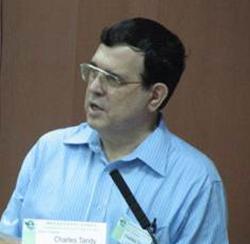
(Photo) Charles Tandy, Ph.D. (2007)
Dr. Charles Tandy received his Ph.D.
in Philosophy of Education from the
Dr.
Tandy’s research and teaching in the general humanities (liberal arts)
typically relates to one or more of the following four areas: Biomedical
Ethics; Futuristic Studies; Global History; Interdisciplinary Philosophy. Much
of Dr. Tandy’s work focuses on “big picture” issues related to the future of
humanity. For example, how may our worldviews, technologies, and decisions
affect future human existence? (Such profoundly important issues are
under-explored and under-funded. Too often, such studies are flawed by
present-centric, ethno-centric, or discipline-centric thinking. In life,
politics, and scholarship, our foresighted, global, and interdisciplinary
perspectives are dangerously underdeveloped.)
Dr.
Tandy is a pioneer in time travel and suspended animation. He is author of
scholarly publications on the ethics and metaphysics of time travel and
suspended animation. He has argued that sooner or later the perfection of: (1)
forward-directed time travel (for example, biostasis)
is “very likely”; and, (2) past-directed time travel (for example, time
viewing) is “likely” (given reasonable assumptions explicitly stated by him).
Dr.
Tandy is dedicated to encouraging scientific advancements while helping
humanity to proactively prevent doomsday and to wisely foresee and manage
catastrophic risks and possible misuse of increasingly powerful technologies,
including bio-technology, nano-technology, and
info-technology, as we move towards a technological singularity. In some
situations it is both desirable and feasible to ban technology or to promote
technology or to relinquish technological capacity in favor of the public
interest, so as to prevent doomsday and wisely manage risks and opportunities.
(For example, Dr. Tandy opposes action to build space-based weapons. For
example, Dr. Tandy favors action to build self-sufficient self-replicating
extraterrestrial green-habitat communities. For example, Dr. Tandy opposes the
For more information about Dr. Tandy,
see <http://www.doctortandy.com/>.
His email address is <cetandy@gmail.com>.
_________________________________________________
ABOUT THE ASSISTANT EDITOR
(Franco Cortese)
Franco Cortese is
a futurist, an author, and an Affiliate Scholar at the Institute for Ethics
& Emerging Technologies. For more information about him, see <http://ieet.org/index.php/IEET/bio/cortese/>.
_________________________________________________
WOULD YOU
LIKE TO SUBMIT A MANUSCRIPT?
Before
submitting your manuscript, first contact the Editor-In-Chief (Dr. Charles
Tandy <cetandy@gmail.com>) or the Assistant Editor (Franco Cortese).
_________________________________________________
This Webpage Was Last Updated
On: